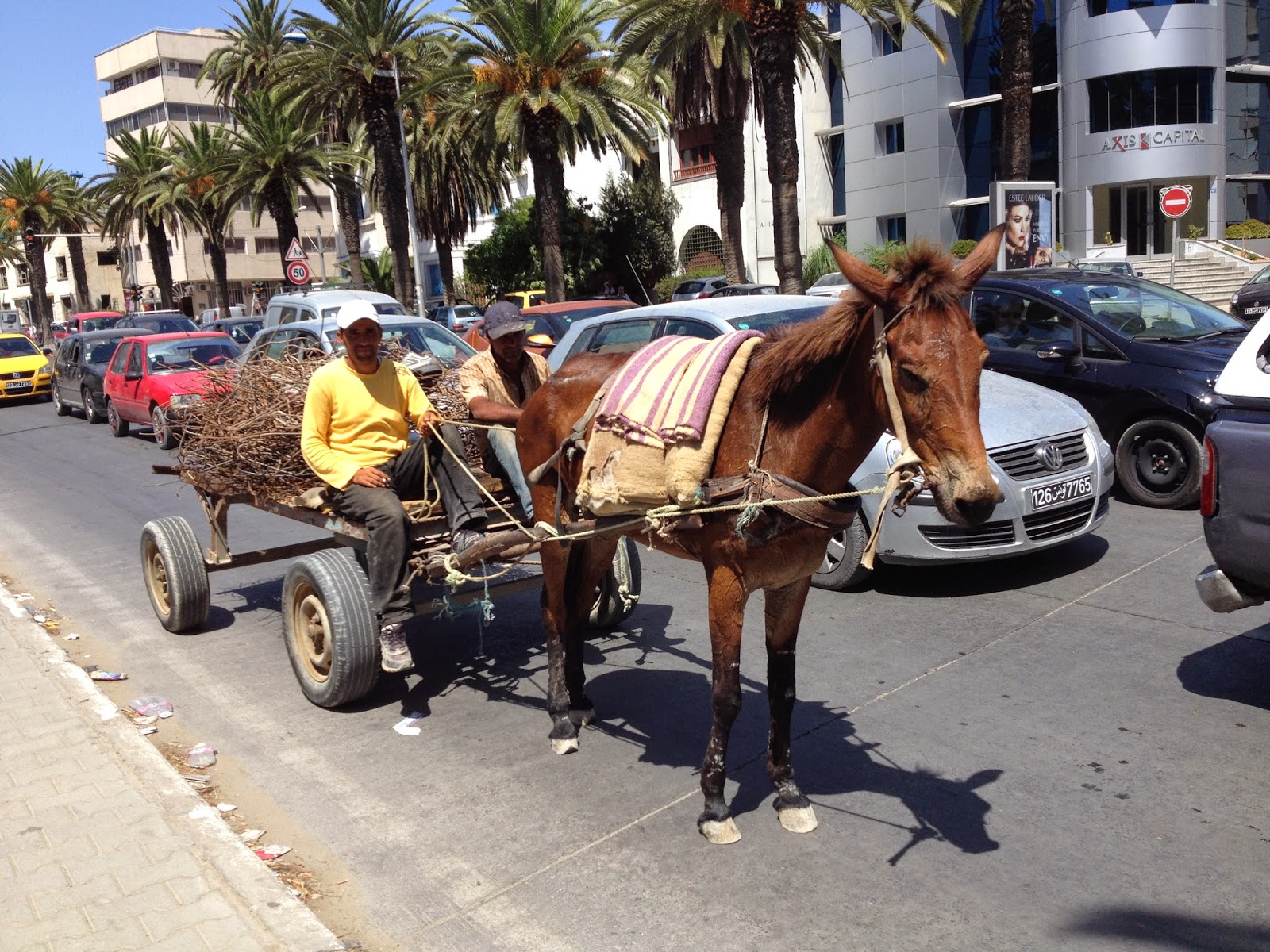
Donkey and people

Donkey and people
Here we are in Tunisia! Dr Jaber Belkhiria and Dr Tricia Andrade were awarded a University of California at Davis Blum Center Poverty Alleviation through Sustainable Solutions graduate student grant. We will be here for a month to assess the role of Tunisian donkeys in development.
Showing posts with label Donkeys. Show all posts

Tuesday, September 23, 2014

Donkey doctors on duty


The dry empty landscape of Mashreq Shams is not particularly inviting. The mountains in the distance no doubt have frightening military stories to tell. Sparse rows of olive trees and cactus seem perfectly content by themselves. Equine carts with drivers intent on their destination ignore our truck passing by. Amine reminds us this is a challenging community to work with as he points out the fortressed well that had its automatic pump stolen. Nonetheless, we were keen to get to the site; veterinarians have a reputation for being a scrappy clan that are not easily deterred.

a barren landscape says 'there's nothing to stop here for'

An empty building behind the school was designated as our workspace, but as we got closer we saw there was no one waiting for us. Amine said "don't worry, they'll come" and he made a few phone calls.
the walled off school with our work site in the distance

We had a meeting at the back of the truck and waited...

One donkey arrived and we took the time for a demonstration...
students and owner focus on Tricia as she explains hoof trim

When we looked up...we were a little overwhelmed with the number of donkeys and people that appeared and kept coming.
welcome patients and their people suddenly appeared from all directions
.
a long line of Mashreq Shams' donkeys wait to be treated
Twice as many donkeys came to the event as we had anticipated and our well laid plans initially got jumbled as we started to work. So many donkeys, so many curious owners eager to see why we were there and what we had to offer. It was difficult to know how much time to spend on each donkey and who to treat next when so many were waiting.


 It is always a pleasure to work with capable people who know how to step up to remedy a chaotic situation and create a system. Amine started an ordered list of owners and Jaber regrouped the teams into two separate work areas. Case by case we tended to the donkeys and made connections with the owners - men, women and children.

Jaber shows a young handler how to gently grasp the tongue to ease looking inside the mouth

Emna gets information from a women dressed in a stylish ensemble
this little guy preferred to stay on his donkey's back during the exam as his mother looks on

The veterinary students wasted no time in proving their professional capabilities and using their new dental and farriery skills.
Zouhair's confidence and smile work magic on the donkeys and the owners

Shadi and Lina use their kind and professional communication skills to give husbandry suggestions to the owners
Ahmed's calm nature easily gains the confidence of two boys as he shows them how to feel the sharp teeth points

Amine (our community development host), who is a drilling engineer, decided to experience being a veterinarian. By the smile on his face, we think he may have missed his calling as a donkey farrier.

Amine, the new hoof engineer

The many donkeys provided an opportunity for us to help each other with challenging cases.


By the end of the day, we'd lost the exact count of the number of donkeys we treated but we know it was at least 48. Our group's good dynamics made the day a success for the donkeys, the community and the team.

teamwork !
 On the next post, we'll highlight some of the interesting cases we saw and the response of the community.

Monday, September 8, 2014

Sights on the Road to Tataouine on September 2


We began our journey south to Tataouine before sunrise and our first stop was to pick up Dr. Emna Brour on the way.  Tricia was still a little weak from the flu and coughing a lot but determined to keep going; Jaber was full of energy and ready for a long day of driving; Emna graciously sat in the bumpy back seat and kept Jaber deep in conversation. This eight hour drive had many examples of the importance of livestock, agriculture and donkeys to the livelihoods of Tunisians - in the present and the past.

The view for our road trip was hundreds of olive tree orchards dotted with people, sheep, dogs, cattle and donkeys. On the road we saw all manner of things being transported – sheep and horses in various sized trucks; chickens, eggs, peppers, tomatoes, and onions tied down in crates; solar panels, bricks and lumber stacked on larger truck beds; men and women in the back of smaller pickup trucks. Alongside the fast moving trucks, people were riding on motorbikes and bicycles (sometimes in the opposite direction of traffic along the fast lane). 

The roadside was dotted with entrepreneurial ventures - many of which were very new sights for Tricia. We passed by barbeque eateries with live sheep and hanging carcasses; young camels waiting to be slaughtered; stands with fresh fruits, pottery and baskets; single tables selling bags of nuts and fruits as well as cups of tea.

And of course we saw lots of donkeys...tethered, loose, pulling carts, alone, with men, women and sheep...in the fields and in the city.

After about four hours we got closer to Medenine, the sun was out in full force and we were grateful for the truck's air conditioning. The landscape shifted from olive trees in gravel fields to date palm trees in sandy desert; we saw more camels. The roadside businesses were predominately fuel vendors selling 5 gallon containers of gasoline brought over the border illegally from Libya. Inside the busy city of Medenine we saw several old donkeys hauling carts driven by old men - both looked lean and active and too busy to pose for a picture.

We met Dr. Ahlem Lahmar in the center of Tataouine and had a quick meal (Tricia was really hungry after three days of illness and took her chances eating in a restaurant) before finding our accommodations for the night in nearby Chenini. 
Tataouine
 
Desert landscape on the way to Chenini

Chenini is a small village which looks like a picture straight from a history book and some of the buildings date back to the 12th century. The modest hotel was in one section of this mountain ksar village of 'castles' which was carefully renovated by a local dentist (who speaks great english). He was very proud of his accomplishment and rightly so, because the authenticity was preserved while creating modern comforts. He was thrilled to hear we came to the area to work on donkey teeth since he has two donkeys. When he arrived here 10 years ago he rented donkeys for 10 dinars a day,  until after four days he realized he could buy a donkey for 40 dinars. He currently uses his grey donkey to carry visitors' luggage to the rooms in baskets balanced over the donkey's back.

Chenini
We got a full tour and history lesson and he explained how the village was built by donkeys. "Everything you see - it was built by donkeys...and the path we walk, it was chosen by the donkeys." He said everyone in the village has a donkey. He walked us up the hill to the nicest room, complete with air conditioning, a television and nearby wind up phone to call the main desk. 


We ended the hotel tour by making a plan to take care of his donkeys and any others in the village before we check out.

the working donkeys of Chenini


Monday, August 25, 2014

Patience and persistence pays off


Today we had to head into central Tunis for meetings. It was a slow start amidst lots of traffic and we were driving around in circles as several arranged meetings got canceled and rescheduled. Patience and persistence triumphed.


Jaber put his cellphone networking and multitasking skills to good use and we were able to make our meeting with Malek Lakhwa a priority. We were hoping he would be a key community partner for our project because he has participated in donkey veterinary service events, owns an olive oil farm, and is an entrepreneur as well as a medical doctor.


We were not disappointed in our meeting. Malek listened carefully to what we wanted to do and offered his farm and community connections. Malek was full of information about the status of donkeys in general in Tunisia and local craftsmen who make harness equipment. He told us about his volunteer efforts with NGOs and the attitudes of local residents towards their donkeys, where many place little value on the donkeys. The owners use the donkeys mostly for transportation and don't understand their behavior which results in rough treatment. We talked about addressing human behavior changes and hope in school age children. He shared his concerns about the increase of donkeys being butchered for meat and the poor conditions of their transport and quality control of the meat. 

Just as we were talking about the welfare of donkeys, a cart went by with a thin mule who looked very stressed and had sores on his mouth and squinting runny eyes. The drivers were friendly and told Tricia to pet the mule. It was hard to walk away and not give advice or treatment.


Malek is very fond of the four donkeys he owns and is keen to improve the health of donkeys in Tunisia. It was inspiring to hear about his entrepreneurial adventures of making soap from donkey's milk (he is the only person his donkey, Cleopatra, will allow to milk her). We also began brainstorming about marketing the soap and agri-eco tourism ideas involving donkeys. Anyone interested in buying donkey milk soap or a working vacation on an olive oil farm and going on donkey hikes?

We agreed respecting local culture and starting small to build a good foundation is key for actionable plans to become realities.  We made arrangements to visit his farm in Zaguan on Wednesday which is about two hours from Tunis.

Tricia Andrade and Malek Lakhwa

Sunday, August 24, 2014

Camel Consultations and Human Connections

There is something universal about the connection between humans who love their animals and the veterinarians who provide care. We listen to the human being, and we treat the animal; in the process we show our caring for the person. If we are lucky, that person expresses their caring for the veterinarian. It may come in the form of money, a handshake, or a dozen eggs. Today, it was a camel ride.

On a drive Saturday, we passed by a seaside area with three camels in a parking lot. As we approached the camels, the owner saw we wanted to take pictures and began to ask for money. Jaber told him Tricia was a visiting veterinarian and the photo opportunity quickly turned into a veterinary consultation.


The camels were a family and the yearling had recently eaten an excess of fibrous cereals. We asked all the right questions about history, inspected the package of probiotics he had administered, and learned about his home remedies, which included vinegar. The camel was recovering from a depressed appetite, but was still weak from acidosis. We made our recommendations to discontinue the vinegar and try baking soda and beer.


The owner expressed his gratitude for our concern and offered Tricia a ride on the Momma Camel. Needless to say, this was a novel experience even though she is an experienced equestrienne.  The owner further showed his trust in us by handing Jaber the leadline.

UC Davis School of Veterinary Medicine Ambassadors. One animal at a time.

Saturday, August 23, 2014

Our first donkey


We stopped to get diesel for the truck close to Jaber’s home on our way to meet with another veterinarian. Surprise! We saw a man walking next to his donkey pulling a cart. Tricia is still not used to such sights and asked Jaber, “Can I take his picture?”. Yes, of course. The first shot was from afar so as to not disturb the man, but as soon as he saw me with my cell phone camera, he waved and stopped to pose. Then he left the donkey hanging out and he went across the street.

We walked over to say hello to the donkey and check out the cart. The small donkey had slits (fully healed) extending up from each nostril and moderately long hooves with chips. The man came back and had a conversation with Jaber. He told us the slits were to help the donkey breath better and be stronger. Tricia asked, “How old is the donkey?” and the man spread the donkey’s lips to check his teeth, and pronounced “ not very old!” However, Tricia thought otherwise based on the grey hairs, sunken eye orbits and the aged incisors but kept her opinion to herself.

Tricia’s been here only a few days, but it is obvious language lessons are in her future. Jaber is a great translator and information collector but it is frustrating to not be able to speak up. Smiles can only get you so far.

Getting the official authorisations to work


Today we had a meeting with Dr. Hajer Kilani Dequiche at the Tunisian Ministry of Agriculture – she is responsible for information collection, communications and international inspections. She endorses our work with the donkeys and will send an email letter of introduction and support to the state veterinarians in the areas we intend to work. This will help smooth the possible conflicts with local private veterinarians.

Jaber made contact with Malek Lakhoua from Zaguan Olive Oil Farm (Malek's website) who is very interested in working with us. He is a medical doctor who has a few donkeys and would like to develop ecotourism in his region. His farm is about 2 hours away in the northern half of Tunisia.
Jaber made arrangements for donations of vaccine and dewormer from a veterinary colleague who works for a pharmaceutical company in Tunisia.